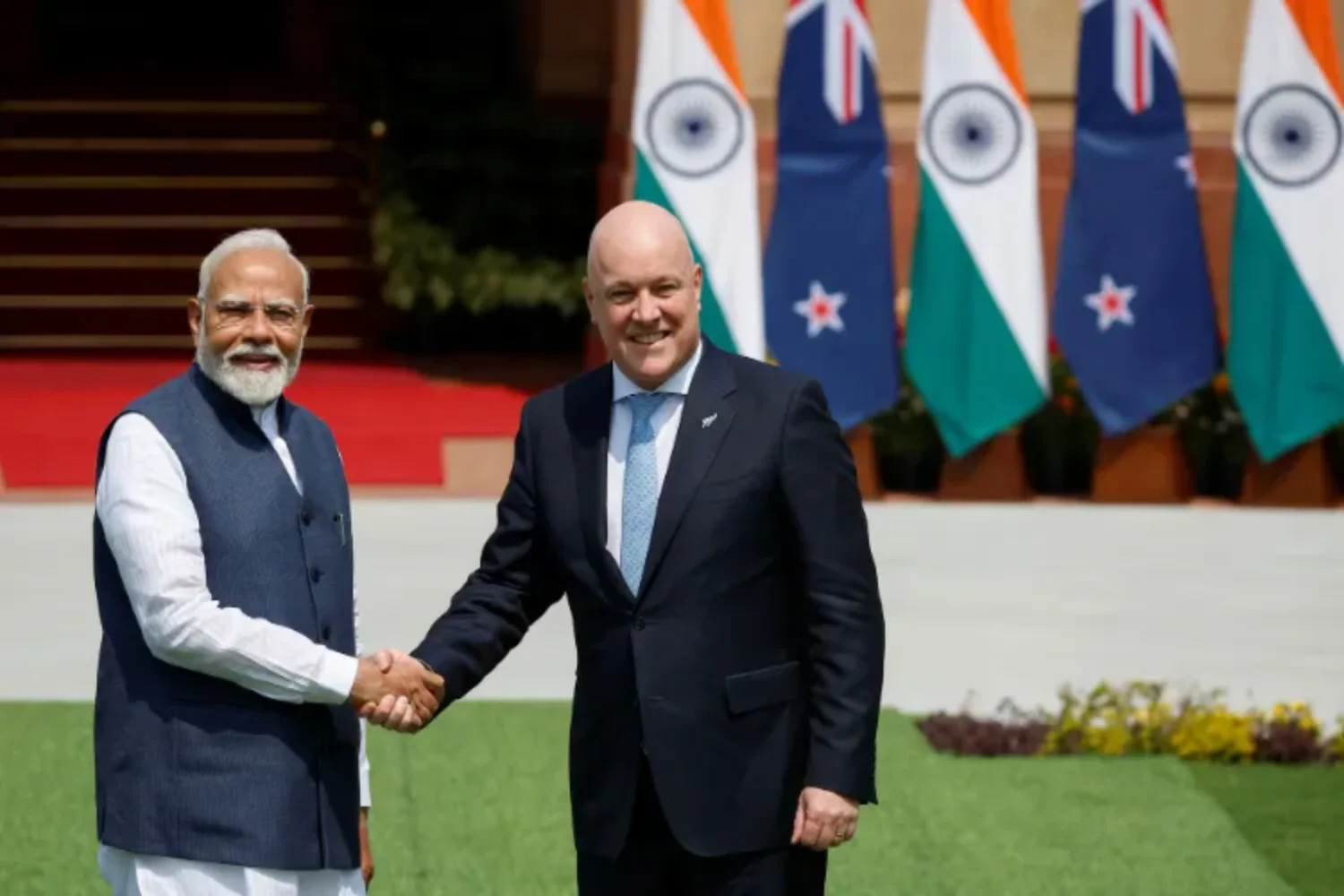


India and New Zealand have announced a major free trade agreement (FTA) that will make most goods traded between the two countries duty-free. The deal was announced on Monday and is expected to be signed in the first half of next year. Both sides will review the agreement after one year.
Calling it a historic step, New Zealand’s Trade and Investment Minister Todd McClay said the agreement will remove or reduce tariffs on 95% of New Zealand’s exports. Around 57% of New Zealand goods will become duty-free in India from the very first day of the pact.
As part of the agreement, New Zealand will invest nearly $20 billion in India over the next 15 years. The deal will also improve mobility for Indian professionals, skilled workers, and students who wish to work or study in New Zealand.
India has been allowed complete duty, free access to New Zealand for its exports of all products. Essential sectors like textiles, apparel, leather, footwear, marine products, gems and jewellery, handicrafts, engineering goods, and automobiles are part of this.
The Union Commerce Minister Piyush Goyal mentioned that the deal is not only about trade but also about people. He further said that the FTA will expose Indian businesses to worldwide opportunities and also be beneficial for Indian youth as they can go abroad to study, work and enhance their skills.
Under the deal, India will cut tariffs on products such as sheep meat, wool, coal, and most forestry and wood exports from New Zealand. India will also allow duty-free access for dairy inputs and other food ingredients that are meant for re-export.
Nevertheless, in order to safeguard local farmers and industries, India has kept out a number of highly sensitive products from its commitments. These are products like dairy products, coffee, milk, cream, cheese, yoghurt, whey, onions, sugar, spices, edible oils, and rubber.
The top management in the industry have accepted the decision with open arms. Ranjeet Mehta, CEO of PHD Chamber of Commerce and Industry, said that the pact provides a stable environment for the government to work its policies and reduces the cost of producing goods, thus it is instrumental in creating strong economic growth over the long run.
Trade between India and New Zealand is still relatively small but growing. Bilateral merchandise trade stood at $1.3 billion in 2024–25, while total trade in goods and services reached $2.4 billion. India’s commerce ministry said the FTA will provide a stable and predictable framework to unlock the full potential of the relationship.
This pact marks the third such trade liberalization India has accomplished in the current year after the UK and Oman deals and is noteworthy in the context of New Delhi’s efforts to diversify away from the US market which has recently imposed tariffs on Indian exports.
Through this new FTA, India intends to ramp up the export of made, in, India goods, draw foreign capital, and deepen trade and economic cooperation with reliable global partners such as New Zealand.