

Rupee Extends and Loses Streak in the Early Trade
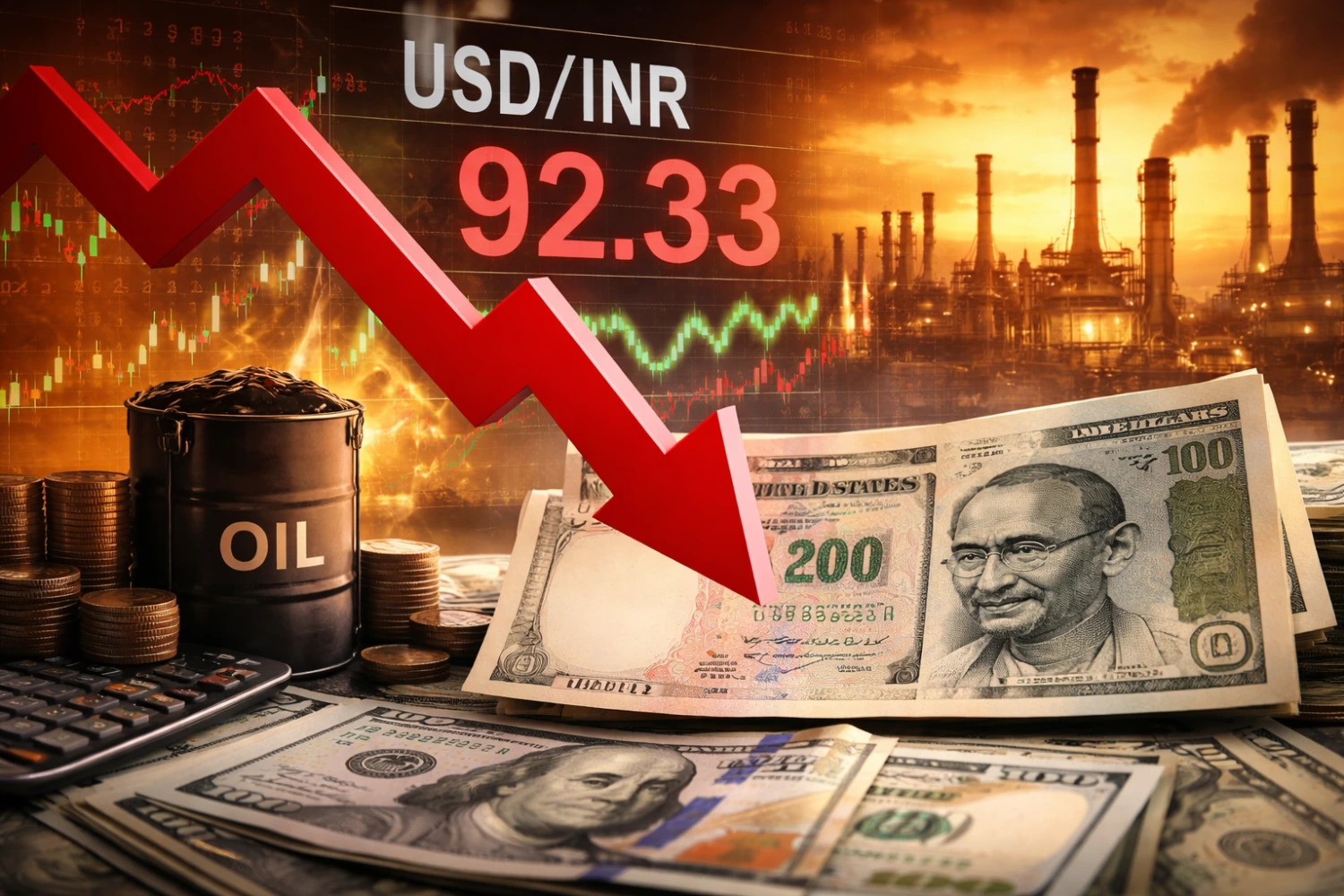
In the Indian market, the Indian rupee was able to continue its long downtrend on Tuesday registering the all-time record lowest in the range of 90.83 in comparison to the US dollar in the early interbank trade. The currency of India opened weaker at 90.79 dollars and then fell further throughout the day as persistent dollar demand, outflows of foreign funds and a cautious market outlook affected currency exchange rates.
The latest drop has extended the rupee’s slump over multiple sessions that has been triggered by both domestic and global influences. The currency dealers noted that the trend was largely unbalanced with a limited amount of support appearing despite the occasional expectation of intervention.
Previous Session Closing and Intraday Motion
In the last session, the rupee was already trading at an historic low at 90.73 dollars following a dip to lower levels in the intraday market. Tuesday’s trading opened showed that the bearish mood was not going away as the currency quickly breaking through earlier support levels.
In intraday trading during the day, the rupee remained close to records lows, which reflects the market’s perception that the prospects for recovery in the near term are bleak. Market participants noted that selling pressure increased as importers sought to cover the cost of dollar obligations, while exporters remained in the background.
Strong Demand for Dollars from Importers
One of the main drivers for the decline in the rupee is the booming demand for dollars from importers especially oil marketing companies and businesses that rely on foreign raw materials. The country’s high dependence on imported crude oil, electronic equipment and industrial equipment has increased the demand for dollars, particularly in a period when the currency of the world remains strong.
Market participants claimed that importers were actively securing for future payments, in anticipation of an increase in rupee strength. This stance exacerbated supply-demand mismatches on the market for foreign exchange and aggravated the downward pressure on the currency in the country.
Inflows of foreign institutional investors Increase Pressure
Consistent international institutional investor (FII) withdrawals from Indian debt and equity markets have contributed significantly to the decline of the rupee. Foreign investors continue to reduce their out exposures to developing markets which includes India in the face of global uncertainties and generally appealing returns in the developed markets.
Foreign investors are forced to leave domestic assets, the exchange of dollars into rupees increases the demand for US currency. Dealers reported that outflows of dollars have been steady over the last few sessions, which has slowed any improvement for the rupee.
Global Risk-Off Sentiment Counts on Emerging Markets
The weakness of the rupee has been a reflection of the general trend across new market currencies. A general negative sentiment towards risk in the world’s financial markets has led investors to invest in safe investments, especially in the case of US dollar.
The concerns over the global economy’s growth as well as geopolitical events and uncertainties about the future monetary policy decisions of central banks have heightened market volatility in the currency market. In the end, the currencies of emerging markets, such as the rupee, are in a state of constant stress.
The strength of US Dollar Index
The US dollar index is a measure of the strength of the greenback against the major currencies, has remained high. A strong dollar has diminished the attraction to emerging market currencies which makes it more difficult for the rupee to stabilise despite India’s generally robust macroeconomic foundations.
Analysts from the Forex market said that the firmness of the dollar is due to the robust US economic data as well as the continued demand for dollars-denominated assets thus accelerating the downward trend of the exchange rate between dollars and rupees.
Trade-related uncertainty adds to volatility
Uncertainty over changes in the world of trade and the lack of clarity about bilateral trade agreements have heightened market anxiety. Inconsistency and delays in developments in trade talks have raised doubts about the outlook for India’s exports which has impacted currency sentiment.
The traders noted that trade-related headwinds, as well as higher taxes on exports have impacted the outlook for future dollar flows, which contributes to the continued decline of the rupee.
A dwindling trade deficit fails to bolster the Currency
Despite an apparent reduction in the trade deficit of India however, the rupee is unable to sustain its support. While smaller trade deficits tend to reduce pressure on the currency, by decreasing net outflows of dollars, market participants claimed that some other factors may have slowed this increase.
Dynamics of the flow of capital and the demand for importer hedging and risk-aversion in the global market have outweighed the positive effects of improving trade statistics, keeping the rupee under pressure.
The role of a non-deliverable forward market
The activity within this market for non-deliverable futures (NDF) market has also had an impact on rupee fluctuations. Dealers have said that coming NDF maturity and offshore positioning has added instability, which has contributed to the short-term weakness in the offshore market.
The increased hedging of importers in both offshore and onshore markets has increased the gap between demand for dollars and supply, putting further pressure on the rupee.
The participation of exporters is limited in the Forex Market
Exporters have demonstrated an unwillingness to trade dollars at the current level and are expecting a further decline in the rupee. This decrease in the supply of dollars has exacerbated the imbalance within the market for foreign exchange.
Exporter activity usually provides temporary support for the rupee, however a lack of activity in recent sessions has resulted in a market tilted towards the dollar.
RBI Intervention Expectations to Stay Indicated
The sharp decline in the rupee has brought back discussions about possible Reserve Bank of India (RBI) intervention. Central bank officials have previously, intervened via the spot and forward markets to limit excessive volatility.
However, traders say all interventions thus far have been a little more measured than aggressive. Market participants believe that the RBI allows the currency to adapt to global trends and intervening only to stop any unruly movements.
Foreign Exchange Reserves Provide Buffer
India’s reserves of foreign exchange remain at an acceptable level providing a buffer against external events. Analysts have pointed out that the existence of large reserves allows policymakers to handle the risk of volatility without consuming resources.
However, despite this buffer, the central bank seems to be cautious about using reserves in large quantities and is instead focusing on ensuring the market in a controlled manner.
Effect on Equity Markets
The decline of the rupee has been in line with the weakness of equity markets in the domestic markets. Indexes of benchmarks started lower, due to foreign sales and currency depreciation weighed on the investor mood.
Market participants say the interaction between outflows of equity and weak currency has resulted in an feedback loop, with each enhancing the other during times of greater risk.
Import Costs and Inflation Concerns
A lower rupee can raise concerns regarding the possibility of inflation in the import market in particular for commodities that are priced in dollars, such as crude oil. Costs for imports that are higher can eventually affect domestic prices if depreciation continues.
The economists said that although inflation remains under control at present, prolonged weakness in the currency could impact the outlook for inflation, particularly in the event that global commodity prices rise in tandem.
Exporters Benefit from the Marginal Competitive Advantage
However, an appreciation of the rupee provides some degree of competitiveness for exporters since overseas profits translate into higher rupee realisations. Industries such as pharmaceuticals, information technology, and textiles could profit from exchange rates that are favorable.
However, analysts warned that global demand and trade restrictions could restrict what exporters can profit on the weakness of their currency.
Rupee Performance in the context of Asian Currencies
Comparatively to regional peers the rupee has been deemed among the worst-performing Asian foreign currencies in the last year. While many markets have been impacted by losses, the rupee’s slide has been more pronounced because of a combination of global and domestic market pressures.
Analysts for currency said the rate illustrates the sensitivity of rupee to capital flows as well as global risk confidence.
Near-Term Trading Range Expectations
The forex market expects the rupee’s price to be in an price range that ranges from 90.30 or 91.00 for a dollar in the near future according to market dynamics and global signals. A rise in risk-aversion or an increase in demand for dollars may provide temporary relief.
In the meantime traders remain cautious noting that volatility will persist as markets continue examine global economic trends and policy indicators.
Market Concentration on Domestic and Global Triggers
Markets for currencies are focussed on the coming global economic data, central bank signal and geopolitical events which could affect the course of the dollar. On the domestic front, attention is focused on trade data, as well as the policy response.
The rupee’s direction in the coming days will be largely dependent on how these elements develop and the mood is currently tilted towards a cautious stance.
Monitoring of Policymakers and Market Participants
Market participants and policymakers are keeping an eye on the direction of the rupee as it moves towards historic lows. Investors, corporations and banks are changing their strategies for hedging to mitigate currency risk amid the increased risk.
The decline of the rupee’s value from 90.83 with respect to the US dollar highlights the difficulties faced by emerging market currencies in the present global economic environment in which market pressures continue to challenge the resilience across all asset classes.